What is my profile?
Software developer, quite tech-savvy and self-taught, I like to experiment on my own.
What were my needs?
During the self-construction of our house, several needs emerged.
On the 3 axes:
- Comfort:
- Implementation of a multi-room audio system
- Media Center
- Ambient lighting
- Lighting management
- Shutter management
- WiFi control
- Information gathering
- Voice control
- Presence management
- Security:
- Alarm
- Video protection camera
- Presence simulation
- Energy savings:
- Control of air conditioners
We wanted to avoid using WiFi as much as possible since we turn it off when we are not using it (it only serves for tablets and laptops).
As you can see, our need is mainly focused on comfort.
Regarding energy savings, having underfloor heating, controlled by a heat pump (with integrated ECS tank), connected to a central wired thermostat, we wondered about the domotization of this heating system after cost.
Underfloor heating has a long inertia of about 6 hours and has a very good yield, so the additional cost of domotizing this system seemed superfluous to us compared to the possible energy gain. Thus, the heat pump regulates itself automatically.
The interest might have been the possibility of turning it on and off remotely during our vacations, but we do not turn off the heating when we leave because of the long inertia and to avoid the building working with large temperature variations.
How I got into home automation
During the construction, we ordered wireless Profalux roller shutters communicating in ZigBee.
I came across their remote control Zoé called « domotics » and that’s when I got interested while the construction had already well started.
Today, with hindsight, the domotics offered by this remote control is quite rudimentary, possibility of programming on time slots and according to sunrise/sunset, that’s all.
I started by installing Domoticz on a Raspberry Pi 3B then I was seduced by the modernity and the sexy interface of Gladys, its community and the open source side.
What hardware I chose
A good diagram is better than a long speech:
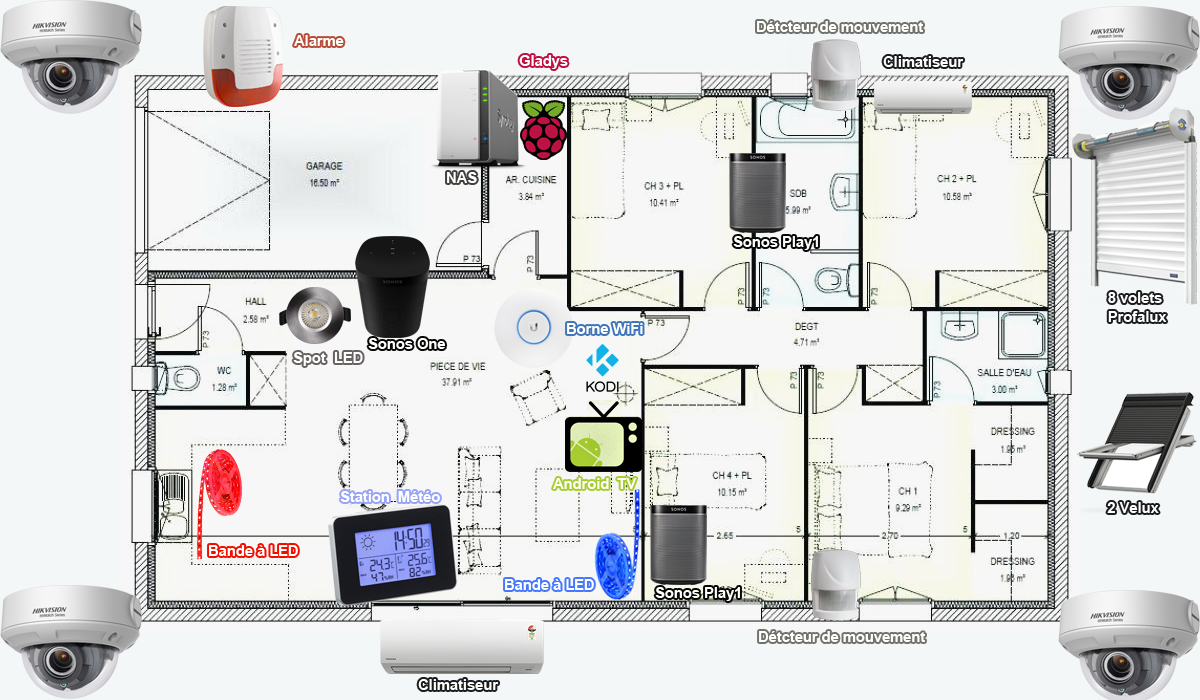
Implementation of a multi-room audio system:
- 1 connected speaker with voice assistant: Sonos One (in the living room)
- 2 speakers: Sonos Play1 (in the bathroom and office)
Media Center:
- 1 Android TV Beelink GT1 Ultimate box with Kodi
Ambient lighting:
- 1 RGB LED strip under the ceiling in the living room
- 1 RGB LED strip under the kitchen skirting boards
- RGB RF 433 MHz receivers
- 2 GLEDOPTO C - 008 ZIGBEE RGB / CCT receivers
- 1 RFLink 433 MHz gateway
Lighting management:
- Domotization of the LED spot switch in the entrance via a Chacon DIO module
Shutter management:
- 8 Profalux ZigBee roller shutters
- 1 Profalux Zoé remote control
- 1 ZigBee Zigate gateway
- 2 Velux SSL solar IO Homecontrol skylight shutters (no solutions found yet)
WiFi control:
- Wired PoE Ubiquiti WiFi access point
Information gathering:
- 433 MHz temperature/humidity sensor from a weather station
Voice control:
- Sonos One via Google Assistant or Amazon Alexa
Presence management:
- Bluetooth of the Raspberry Pi 3B
- Nut mini Bluetooth keychain
Alarm:
- Commercial alarm
Video surveillance camera:
- 4 PoE Hikvision wired cameras
Presence simulation:
- Via the entrance light and the shutters
Air conditioner control (soon):
- Infrared transmitter
The most important, the implementation:
433 MHz:
- Ambient LED strips (kitchen and living room)
- DIO switch module for the LED at the entrance
- Temperature/humidity probe from a weather station
- WiFi Poe base via a Chacon DIO socket
- Motion detectors (in bathroom and bedroom for scenarios)
Ethernet IP:
- Android TV Kodi box
- Sonos One
- 2 Sonos Play1
- Synology NAS (for multimedia management and cameras)
- 4 PoE Hikvision cameras
- Gladys on a Raspberry Pi 3B
Infrared (soon):
- Air conditioner controller
ZigBee (soon):
- Profalux shutters
- GLEDOPTO LED controller
- Xiaomi temperature probes to control air conditioners
The scenarios
In the morning when waking up, the shutters open and the radio starts on a Sonos.
My wife has the possibility to turn on the living room LED strip by passing her hand towards the floor thanks to a motion detector under the bed when she gets up earlier to avoid waking me up (within a certain time frame), this allows her to have indirect lighting to move around.
I then ask vocally for the news and the weather.
It would be interesting for it to be automatic when waking up, so I can know how to dress according to the weather.
If there is music playing in the living room, and if you enter the bathroom, the bathroom speaker synchronizes with the living room music thanks to a motion sensor, the latter turns off if no movement is detected for a while.
The shutters close automatically at defined time slots when I leave for work.
It would be great if this was done via presence detection, as well as when we return depending on the time.
The shutters close at sunset.
The WiFi turns off automatically at midnight.
It would be interesting for it to also turn off when there is no activity for 1 hour.
I have a problem with presence detection, the detection works up to about 6m. This range is not sufficient given the size of the house.
I would like to be detected when we are in front of the front door or the garage to:
- deactivate the alarm for example
- suggest a playlist when we arrive
- open/close the shutters
- maybe one day open/close the garage door
Have you been able to test solutions for this? (Bluetooth dongle to plug into the Pi)
What could be the future evolutions of my installation?
- Integrate my ZigBee network when the Zigate is supported (shutters and ambient lighting)
- Domotize air conditioners via an infrared controller
- Domotize Velux shutters (if you have a solution J)
- Add a presence simulation mode that turns on the lights at random time slots
- Manage the 2 states of the RF433 two-state opening sensors
- Turn off the cameras when we are present, via the Synology?
- Add TTS voice announcements to the Sonos
- Add a waterproof button in the shower to control the Sonos
- Add wireless switches where we lack two-way switches
- Be notified by Telegram when the batteries of simple sensors wear out (if no detection for 10 days)
- Be notified by Telegram if a device is controlled during our absence
- Add automatic meter reading (electric via Enedis) and water (via something else?)
- Replace the spots with connected colored spots
- Domotize the integrated lighting of some furniture
- Add an Ambilight to the TV
- Add a Cinema mode (to control the living room lighting, turn on the TV and launch Kodi)
- Replace the TV soundbar + subwoofer with Sonos
- Why not domotize the garage door?
- Domotize the fish food during our vacations
- Domotize the mailbox just for fun
- Set up automated watering and domotize it, that would be the dream for the lawn J
To conclude a small personal experience feedback:
Regarding lighting, I had chosen a 433MHz DIO module for economy, the disadvantage is that there is no status feedback if someone manually operates the switch.I recommend planning for a large junction box of at least 50mm for module passage.
If you’re lucky enough to choose your shutters, find out in advance about the possibility of making them smart and avoid proprietary protocols like IO Homecontrol.
And above all, don’t skimp on the number of RJ45 sockets if you’re building; put in at least one in each room and more if possible.
Debate:
- What do you think about the interest of making a heat pump smart?
- Similarly, for the integrated BECS of a heat pump?
- And for a VMC?
- Do you have any ideas for scenarios for our installation?
- How did you solve Bluetooth range problems for Nuts?
- How do you make your lighting smart while keeping the use of switches?
- Do you have any ideas for making my Velux IO Homecontrol shutters smart?
- If you’ve made your garage door smart, which protocol did you use?
- Do you have any feedback on waterproof control buttons?
 )
)
