A suggestion: Have you planned to do something with ONVIF to be able to activate/deactivate cameras?
Today I have the following configuration:
My cameras are connected to my Synology (ONVIF protocol)
I created a Gladys module that connects to the Synology API for streaming and basic control (activating/deactivating cameras)
This allows me, via scenarios, to turn on the cameras when I leave home and turn them off when I come back. This meets my needs.
But I imagine it must be possible to interact from Gladys in ONVIF on the cameras, which would allow making any camera compatible with Gladys natively. What do you think?
I’m thinking about this as I see you’re working on the stream flows, but in fact, it might be a service to develop rather than a native function like the one you’re developing right now for the streams.
@pierre-gilles: I really like @link39’s idea about activating/deactivating the camera based on our presence. I would also like to have this option . I also have a Synology.
It’s delayed for now. Live will be possible but with more research and experimentation on real hardware to ensure the gear keeps up, and that the network works for everyone.
It’s a whole different pie, and I’m sticking to the Gladys 4 philosophy: « We do fewer things, but what we do, we do well. »
For now, I’ve set a refresh of the image every 60 seconds.
We need to find a compromise between « image too old » and « saturation of the gear and the UI. »
Since this is just a thumbnail to give a view of the room, I think 60 seconds is neither too frequent nor too old. Let me know your thoughts
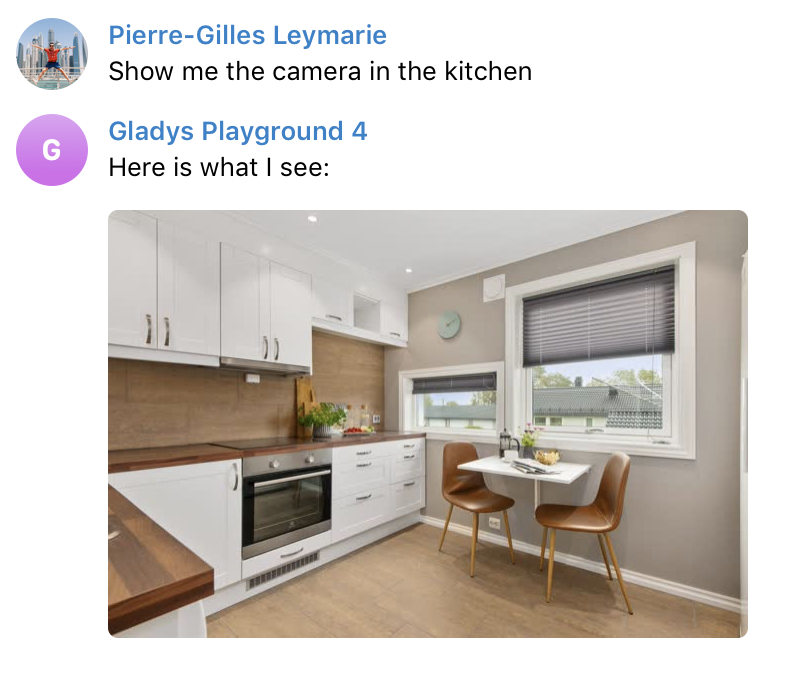
Well, a feature I’m quite proud of, being able to ask Gladys for a camera image in messages!
Possibly off-topic
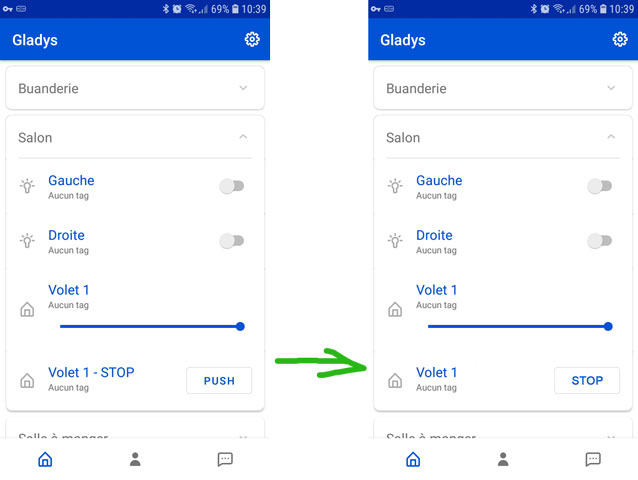
It would be great to be able to customize the name of the PUSH button
Instead of writing PUSH on the button, you could write the function, currently in v3 this is not possible
For my part, I find that a bit long. Would it be possible to have a default frequency, 60 for example, and let the user set the frequency if they wish? Depending on the machine running gladys, the hardware saturation will not be the same.
I must admit that I’m not a fan of putting parameters everywhere. This adds complexity to the app in terms of UI and behavior. The user should not have to wonder about this kind of implementation parameter.
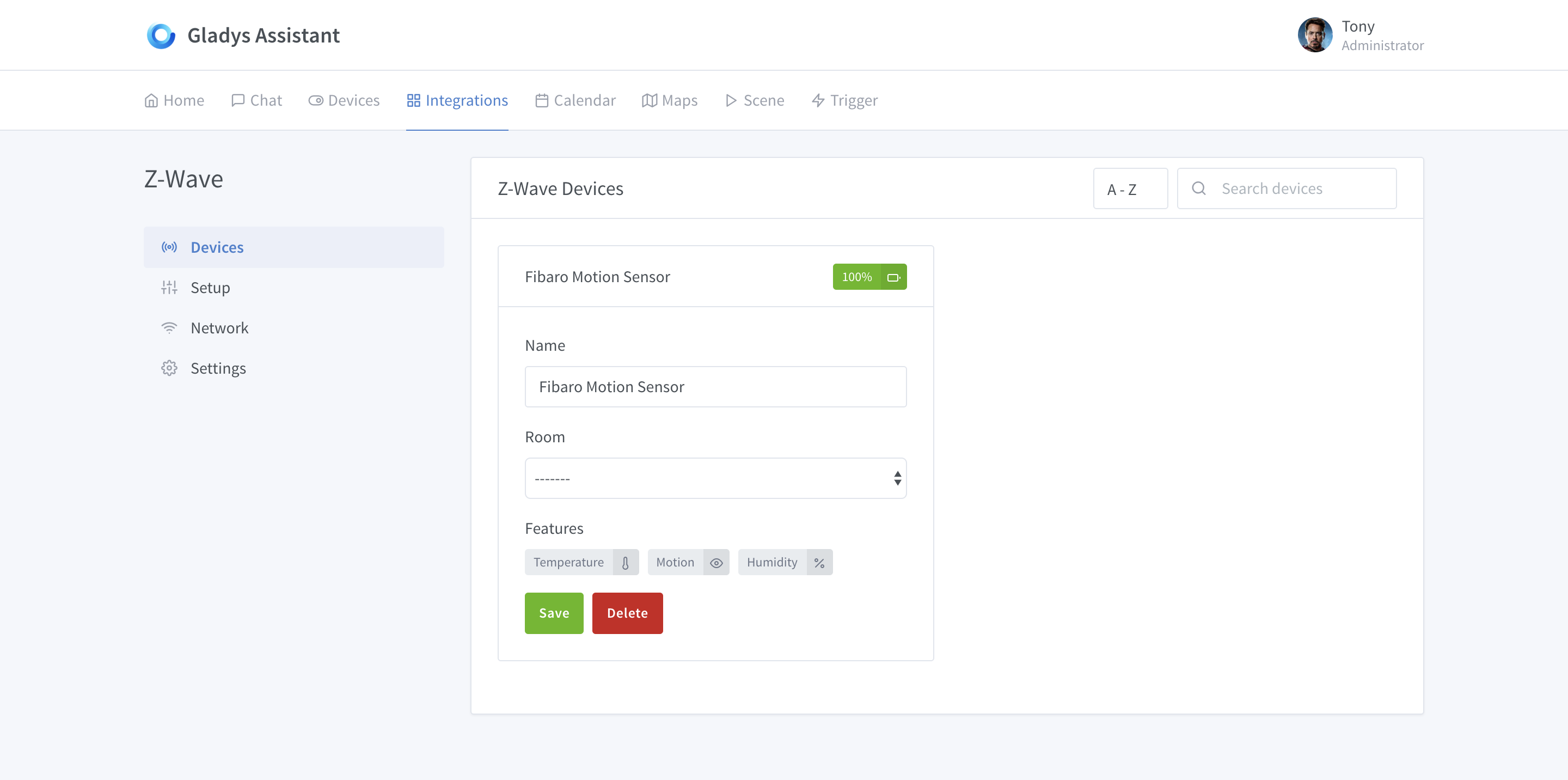
For information, I’m working on the Z-Wave UI today.
I would see a picture every two seconds. I don’t know if a Pi would technically support it, though. It’s not live, but it allows you to have an image that changes quickly enough to know what’s happening at home, like seeing who is ringing the gate, for example.
I agree that you don’t want a machine with so many settings that you don’t know what to do. However, if the refresh rate isn’t right and can’t be changed, users won’t use the solution or even think it doesn’t work because the image doesn’t change quickly enough.
I agree!
2 seconds still seems like a lot though ^^ That’s 43,000 refreshes per day Well, we can always put this option in the alpha, to test it in real life on various hardware. If we realize it’s too heavy, we can remove the option.
I’m not sure I fully understand, are we in agreement that RTSP is a real-time streaming feed, so why add a refresh delay? Isn’t there a way to stream directly and use Gladys simply as a stream gateway?
An RTSP stream cannot be read by a browser, it must be converted on the Gladys server side.
In Gladys 3, @piznel had made a module that streams an RTSP stream to a browser via websockets. The only thing is that it is CPU-intensive, and if the right mechanisms are not put in place, it converts 24/7 and thus the rasp is always working even when the browser is not open.
In addition, it is necessary to ensure that the implementation works even when going through the Gateway.
Overall, it is not so complicated, there is no technical blockage, but the philosophy of the v4 is « we do few things but what we do we do well ».
Let’s start with static, and when we have more hindsight and more tests on different hardware + network configuration, we can move to live.
 . I also have a Synology.


 Well, we can always put this option in the alpha, to test it in real life on various hardware. If we realize it’s too heavy, we can remove the option.