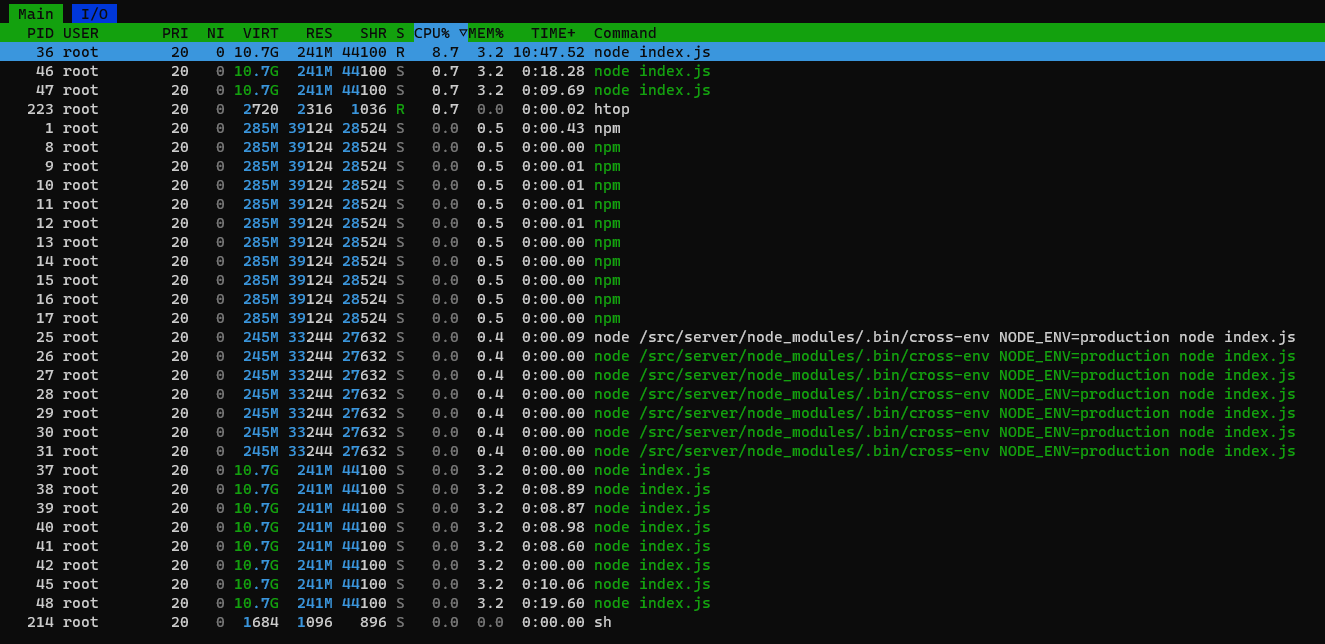
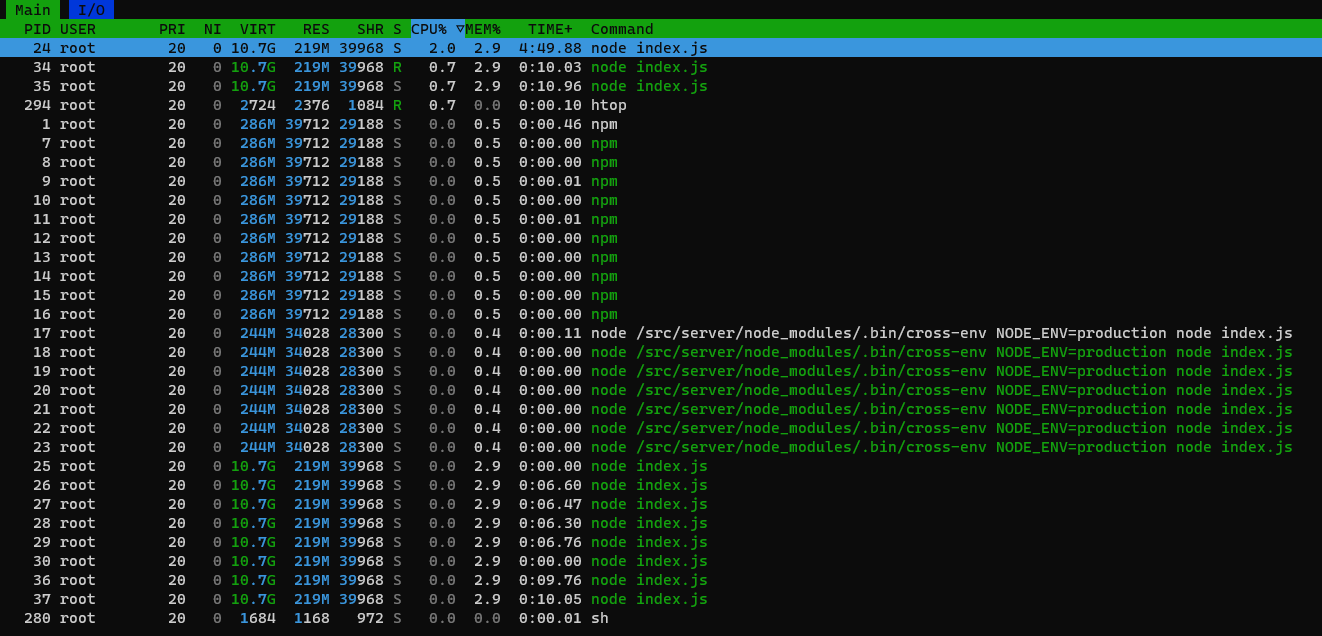
In reality I was rather surprised by the amount of extra CPU used compared to Gladys without the service. Would an outgoing HTTP request be so CPU-intensive?
Wouldn’t we then have to do some kind of « batch », based on a number of events or a delay? For example: every 10 « values » or every 5 seconds.
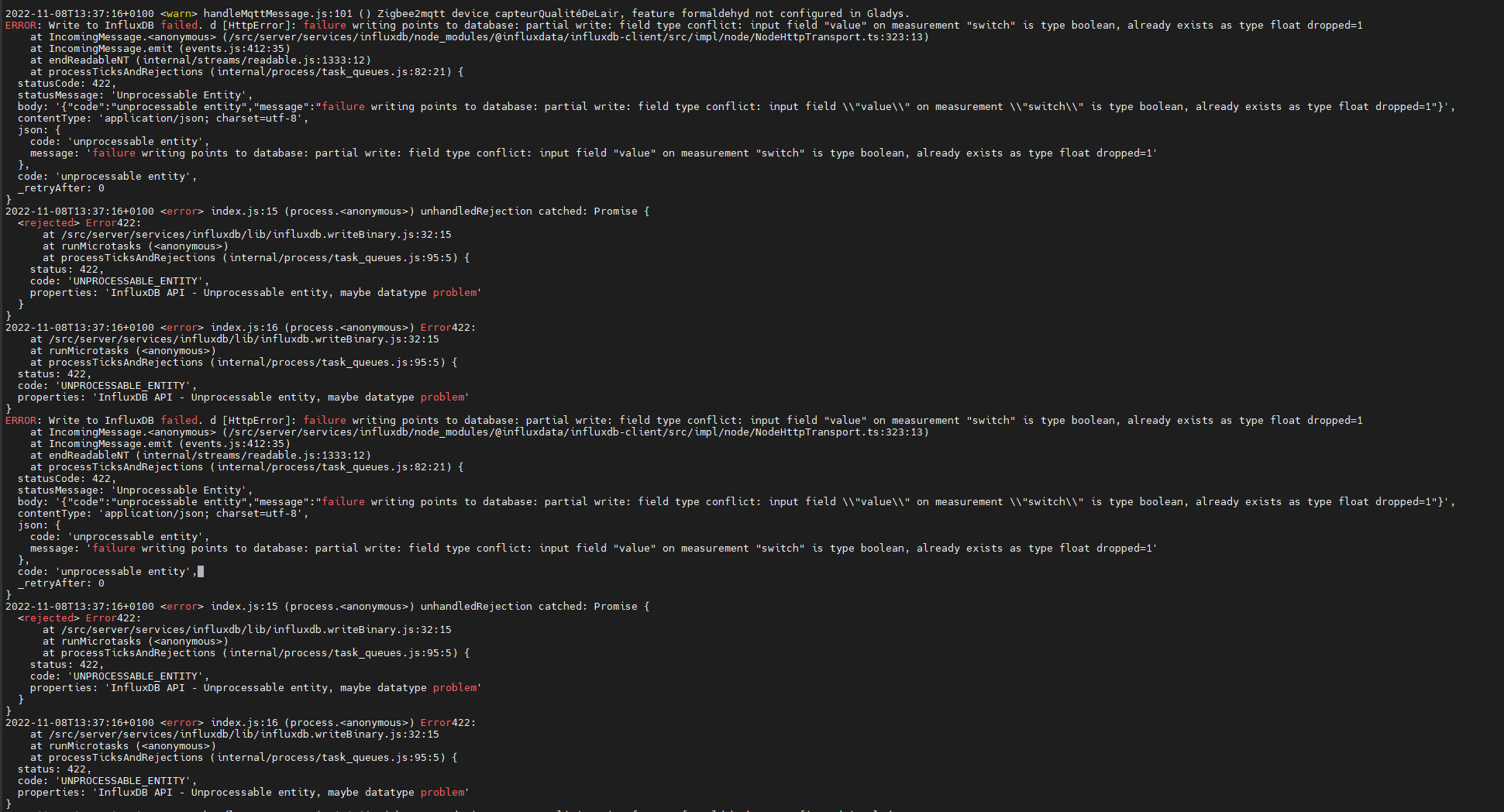
2022-11-08T13:37:16+0100 \u003cwarn\u003e handleMqttMessage.js:101 () Zigbee2mqtt device capteurQualitéDeLair, feature formaldehyd not configured in Gladys.
ERROR: Write to InfluxDB failed. d [HttpError]: failure writing points to database: partial write: field type conflict: input field \"value\" on measurement \"switch\" is type boolean, already exists as type float dropped=1
    at IncomingMessage.\u003canonymous\u003e (/src/server/services/influxdb/node_modules/@influxdata/influxdb-client/src/impl/node/NodeHttpTransport.ts:323:13)
    at IncomingMessage.emit (events.js:412:35)
    at endReadableNT (internal/streams/readable.js:1333:12)
    at processTicksAndRejections (internal/process/task_queues.js:82:21) {
  statusCode: 422,
  statusMessage: 'Unprocessable Entity',
  body: '{\"code\":\"unprocessable entity\",\"message\":\"failure writing points to database: partial write: field type conflict: input field \\\\\"value\\\\\" on measurement \\\\\"switch\\\\\" is type boolean, already exists as type float dropped=1\"}',
  contentType: 'application/json; charset=utf-8',
  json: {
    code: 'unprocessable entity',
    message: 'failure writing points to database: partial write: field type conflict: input field \"value\" on measurement \"switch\" is type boolean, already exists as type float dropped=1'
  },
  code: 'unprocessable entity',
  _retryAfter: 0
}
2022-11-08T13:37:16+0100 \u003cerror\u003e index.js:15 (process.\u003canonymous\u003e) unhandledRejection catched: Promise {
  \u003crejected\u003e Error422:
      at /src/server/services/influxdb/lib/influxdb.writeBinary.js:32:15
      at runMicrotasks (\u003canonymous\u003e)
      at processTicksAndRejections (internal/process/task_queues.js:95:5) {
    status: 422,
    code: 'UNPROCESSABLE_ENTITY',
    properties: 'InfluxDB API - Unprocessable entity, maybe datatype problem'
  }
}
2022-11-08T13:37:16+0100 \u003cerror\u003e index.js:16 (process.\u003canonymous\u003e) Error422:
    at /src/server/services/influxdb/lib/influxdb.writeBinary.js:32:15
    at runMicrotasks (\u003canonymous\u003e)
    at processTicksAndRejections (internal/process/task_queues.js:95:5) {
  status: 422,
  code: 'UNPROCESSABLE_ENTITY',
  properties: 'InfluxDB API - Unprocessable entity, maybe datatype problem'
}
ERROR: Write to InfluxDB failed. d [HttpError]: failure writing points to database: partial write: field type conflict: input field \"value\" on measurement \"switch\" is type boolean, already exists as type float dropped=1
    at IncomingMessage.\u003canonymous\u003e (/src/server/services/influxdb/node_modules/@influxdata/influxdb-client/src/impl/node/NodeHttpTransport.ts:323:13)
    at IncomingMessage.emit (events.js:412:35)
    at endReadableNT (internal/streams/readable.js:1333:12)
    at processTicksAndRejections (internal/process/task_queues.js:82:21) {
  statusCode: 422,
  statusMessage: 'Unprocessable Entity',
  body: '{\"code\":\"unprocessable entity\",\"message\":\"failure writing points to database: partial write: field type conflict: input field \\\\\"value\\\\\" on measurement \\\\\"switch\\\\\" is type boolean, already exists as type float dropped=1\"}',
  contentType: 'application/json; charset=utf-8',
  json: {
    code: 'unprocessable entity',
    message: 'failure writing points to database: partial write: field type conflict: input field \"value\" on measurement \"switch\" is type boolean, already exists as type float dropped=1'
  },
  code: 'unprocessable entity',
  _retryAfter: 0
}
2022-11-08T13:37:16+0100 \u003cerror\u003e index.js:15 (process.\u003canonymous\u003e) unhandledRejection catched: Promise {
  \u003crejected\u003e Error422:
      at /src/server/services/influxdb/lib/influxdb.writeBinary.js:32:15
      at runMicrotasks (\u003canonymous\u003e)
      at processTicksAndRejections (internal/process/task_queues.js:95:5) {
    status: 422,
    code: 'UNPROCESSABLE_ENTITY',
    properties: 'InfluxDB API - Unprocessable entity, maybe datatype problem'
  }
}
Procedure :
Start Gladys with the built-in InfluxDB service
Run a scene from a wireless button
Error
[EDIT]
It looks like an HTTP 422 returned from my InfluxDB server, for an unsupported data type.
Tested as requested, and on my mini PC with an i5 this time.
Same behavior, container CPU used between 6% and 30% while Gladys without the Influx service is at 0%.
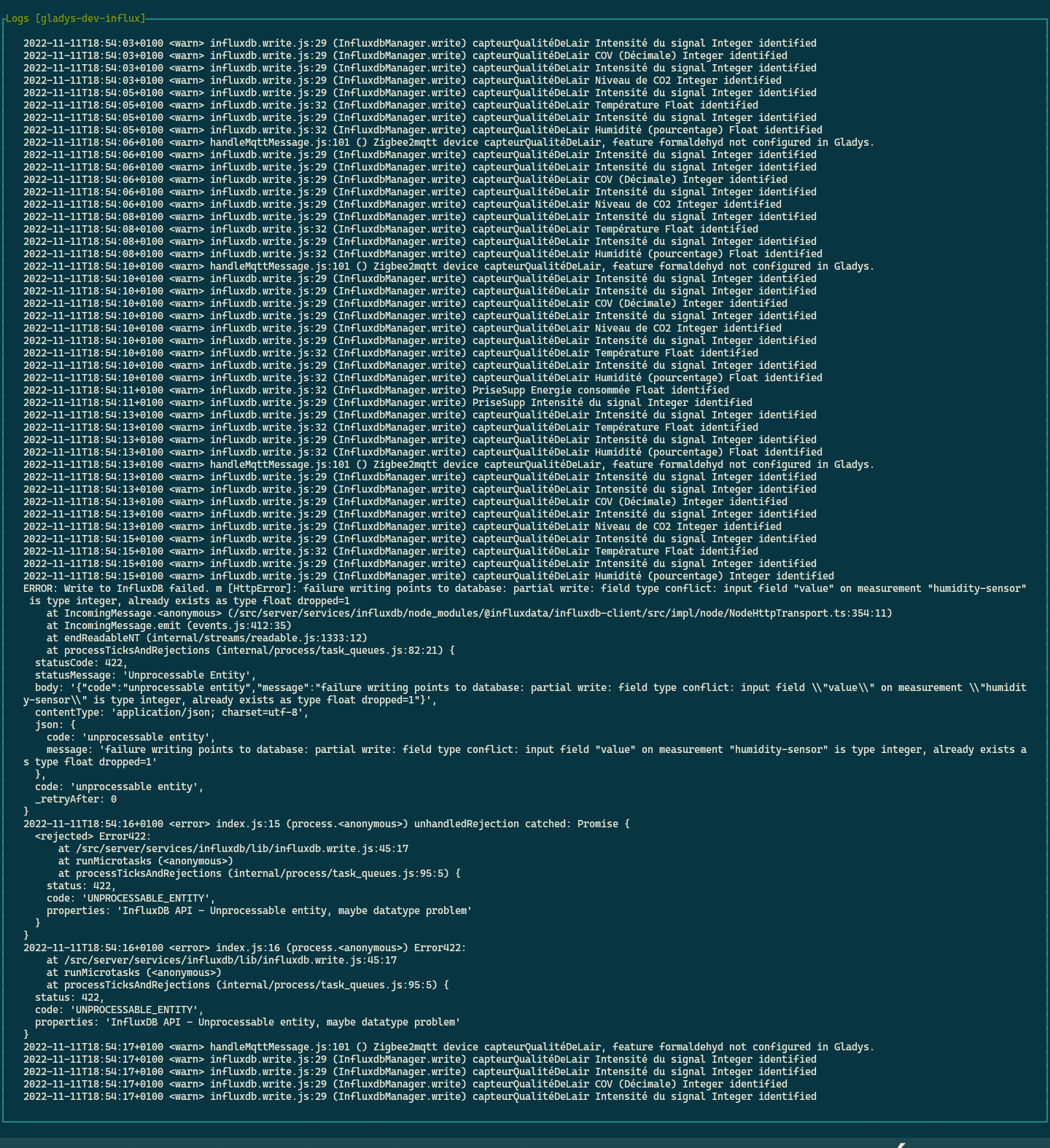
The logs clearly show that the high activity of HTTP requests must be using quite a bit of CPU, I imagine.
My CO2 and VOC sensor is very, very verbose (all data is updated every second).
Finally, there is still an error about a data type, but not the same one this time.
Once I had a similar case, a task that was very resource-intensive because it had to process a lot of data.
By buffering this task with a « batch » we completely solved this problem.
Great — if it’s already possible in the client being used, I hope that will help better optimize resources. I’m thinking that on a few devices at my place I notice an increase in CPU; I can’t even imagine if someone else had the same sensor as me, but in every room!
Otherwise, I also noticed something odd. A docker stats shows me that your container is consuming much more RAM than Gladys.
The CPU of the Gladys Influx container barely exceeds 6% CPU, generally completely in sync with the original container. I can hardly notice any difference in consumption anymore.
For me the service is functional, as long as you add front-end messages like « configuration saved » or « error ».