Official Gladys starter kit launch! šŸš€

@pierre-gilles To add my two cents to the discussion: I, too, hesitated quite a bit before subscribing to Gladys Plus because of a single all-inclusive price (at the time, you only had one rate, if I remember correctly). Basically my reasoning was ā€œsince I’m not interested in everything, why should I pay for everything?ā€, without even really asking myself the value of each offered feature.

Today I know that what I use is well worth what I pay, but I’d say that the way you present your offer can create a barrier.

That said, you obviously couldn’t afford a complicated pricing scheme. But maybe one option would be to say that each individual feature costs €2/month. And that the full Gladys Plus is €9.99/month. And no more need to manage a ā€˜lite’ pack where you might have tried to guess what would interest people who don’t want everything…

L’avantage pour les utilisateurs :

  • no more ā€˜psychological’ barrier to try Gladys Plus
  • An ā€˜Ć  la carte’ offer that everyone can manage
  • A favorable price as soon as 5 features or more interest you

L’avantage pour toi :

  • more new Gladys Plus customers
  • An offer that’s simple to explain
  • An understanding of what truly attracts people when they choose ā€˜Ć  la carte’

But it’s probably technically not so simple to implement… :wink:

3 Likes

Good evening,

For my part, I’m wondering why offer different mini PCs?

Since they will be delivered preinstalled, the user won’t use this PC for anything else. So for me, we should offer a PC that runs Gladys well, one that won’t experience slowdowns, but nothing more. Why pay more for a mini PC of which we’d only use 50% of the capacity. I can’t say which is the most suitable, I haven’t run the tests and I’m certainly not the best person to do them: but if the T5 does the job, I’d go with that. If it’s too tight, then go with the S12 which we already know works.

And if it’s the T5, that allows you to offer a preinstalled box for under €150 (even giving yourself a margin for the time spent, which wouldn’t be unreasonable). I find that very reasonable and competitive, it seems to me.

If it’s the S12, you can also give yourself a margin, but in my view it should stay below €200.

That’s just my opinion, but since you’re asking us, I’m giving it :slight_smile:.

1 Like

Thanks for your very thorough feedback @StephaneB :slightly_smiling_face:

I understand!

I’d be curious to know whether other companies have successfully implemented this kind of strategy, because it’s still very, very complicated :sweat_smile:

With 7 features in Gladys Plus, that’s 2^7 - 1 = 127 combinations :joy:

Even Home Assistant, which has many more users than Gladys, only offers a single plan at €7.50/month, and yet you could say that with their size they would have even more need to segment their offer, and yet they don’t!

Thanks for your opinion!

Gladys’ resource usage depends a lot on each user’s configuration. It’s not at all the same to have 2 connected devices or an installation with 100 devices and multiple cameras, for example.

That’s why I propose different models: everyone can choose the mini-PC best suited to their ā€œtargetā€ usage.

Moreover, many users see their installation as a long-term investment. Their home automation is meant to last several years, so some prefer to opt for a slightly more powerful machine, ready for the future and for possible more demanding features. :slightly_smiling_face:

The Beelink T5 option is aimed at users on a tight budget who want to start small while keeping a solid base.

On the competitor side, Home Assistant offers for example the Home Assistant Green at €109 (excluding shipping).

It’s an even more entry-level machine than the Beelink T5: 32 GB of storage versus 64 GB, and a RK3566 processor that is significantly less powerful than the Intel N4020 of the T5.

Source:

I wonder whether some of the users who could come to Gladys don’t go to HA because they see such an attractive offer.

Hence the idea of also offering an option in this price range, to allow everyone to get started easily.

1 Like

Do you need to worry about all possible combinations? I had in mind a checklist when you subscribe to Gladys Plus ā€˜Ć  la carte’. And the only thing that matters for handling billing is the number of checked features, no matter which ones…

But

1 Like

Hi @bab85,

@pierre-gilles doesn’t mention it, but if I’m not mistaken, you can absolutely use the pre-installed mini PC for any other purpose. It’s not a Gladys OS. It’s a Linux with Gladys pre-installed.

And that’s unlike HomeAssistant OS.

I don’t know if it was successful but Jeedom offers paid official plugins and an expensive service pack. If I recall I paid €85 for the service pack which then allowed me to access all the paid plugins even if I didn’t use them all.
I am a Gladys Plus user (and training) and yet I don’t use the Enedis part because I’m in Alsace and we don’t have Enedis. What matters to me is being able to connect remotely, that’s all. Of course I could have set up a VPN server, installed the clients on all my devices, but I prefer to support the project this way.

Jeedom boxes start at €200 with integrated protocols. If you go cheap, you can get a Lidl box for less than €30; on the other hand you can get a Homey Pro at €350. Both offer basic Zigbee and Wi-Fi.

What will make the difference will be the software, ease of use, the all-in-one.
If I have to pay for something, it’s to have a product ready to use.

I therefore agree with @StephaneB’s idea to offer plug-ins individually and have a bundle, and also agree with @bab85 to have just one machine (from my personal experience: 4 cores, 8 GB DDR4, 256 GB NVMe, Wi-Fi, Zigbee)

The main question is : who is your target?

If it’s tinkerers, they’ll have their gear.
If they’re novices then you’ll have to give them only one solution otherwise you’ll lose them.
If you want to do Ā« mass Ā» sales to otherwise increase your revenue then you’ll need to go through a partner shop to get (much) more visibility (Domadoo?).
Everything you propose in hardware and service is great for technical people, not for novices.

Well I could discuss at length because I’m passionate about this topic (probably my experience as a product manager), but at some point you’ll have to define that target; the sooner the better for future decisions.

One point I disagree with you on is making installation and logistics management free, selling at cost. You need to value it. Selling at cost will in any case always be too expensive for those who cannot/will not pay for a quality product and services.

I’ve always been told that anything that’s free has no value, and that all work deserves to be paid.

(Sorry to be so long but I’m very interested in the project and I think it has a lot of potential)

1 Like

In a sense, yes, because you need to be able to test the Ā« dependencies Ā» between options.

For example, currently, you can’t configure Enedis without the Ā« remote access Ā» part of Gladys Plus. So, if we made Enedis optional, we’d need to test the Ā« Enedis alone Ā» combination.

There are dozens of things to manage: the user may subscribe to remote access on Monday, realize on Tuesday that they also want backup, and on Wednesday Enedis.

Either I do pro-rata subscription calculations, or they end up with 3 subscriptions but with separate billing cycles.

Not to mention that micropayments with the current banking system are not profitable (because there are fixed transaction fees), so €2 options could only be offered annually…

The more I list it out, the more I tell myself that if no one does this, there’s a reason :joy:

Exactly, I just plan to offer a mini-PC that will be installed in the same way as described in the training: Ubuntu + Gladys installed via Docker.

I will provide randomly generated Ā« username/password Ā» credentials for the Linux user account, and the user will be able, if they want, to change anything on the instance :slight_smile:

Jeedom isn’t doing very well actually and in my opinion that’s also due to their positioning.
(And to their aging product, but that’s another topic)

Exactly! I’d be curious to know if Homey Pro manages to break into the French market with those prices, and how they manage to attract their audience.

The target here is a tech-savvy but not expert user, who has an appetite for the Linux world but is a bit Ā« lazy Ā» to do the full installation.

When competitors offer plug \u0026 play boxes, they wonder why they should do things themselves like flashing a USB stick, installing Linux, installing Docker, installing Gladys, etc., with all the risks of Ā« that they won’t be able to do it. Ā»

My theory is that a large part of purchasing psychology would be unlocked with these pre-installed mini-PCs. After all, as always in entrepreneurship, the only way to know is to test :slight_smile:

I understand your point, but for me, the selling price is the meeting point between what the user is willing to pay and what I’m willing to sell it for.

The production cost ultimately only has an indirect link to the final price.

If my cost is too high and I decide to sell at that level, I will only reach a small part of the market: those willing to pay that price.

Conversely, lowering the price expands the user base, which can be more interesting strategically.

I have always seen the starter kit as a loss leader, which then allows offering Gladys Plus, the only truly profitable offering that keeps the project alive.

When I launched the starter kit, sales were good the first year (28 kits in 12 months), but they’ve tapered off since April.

So I’m trying to understand what changed and evolve the offering until I regain a good momentum :slightly_smiling_face:

No, the idea isn’t to do mass sales.

The long-term goal is to have between 600 and 1000 paying Gladys Plus users; that’s the Ā« minimum Ā» threshold for me to be able to work on Gladys full-time. We’re at 95 currently.

So no need to go sell thousands of kits :wink:

1 Like

Thanks for your feedback @pierre-gilles.

I misspoke, I was talking about Gladys’ target audience, not the mini PCs.

When I started in home automation, I bought a Zipabox because it was all-in-one: a nice, compact hub, an integrated Z-Wave module (nothing else to buy), an iOS app (free and dedicated), and a simple, pleasant-to-use interface. In short, nothing to do except plug in the box.
Gladys already delivers ease of use and a very nice UI; it just needs a ready-to-use box and a protocol provided with a dongle (Zigbee at first even if Matter will become the central point).
It may not be a product for right now, but I can definitely see it for later.

A small thought that crosses my mind as I write these lines.
If you offer a single all-in-one product, a non-cloud solution, compatible with a radio protocol and above all compatible with Matter, with 6 months of Gladys Plus (I find 1 year too long, personal opinion, for a visible ROI sooner) and 6 months of training (I don’t know if that’s possible), you could reach a lot of home automation, tech and mini-PC sites/blogs with a new offer that finally democratizes Gladys Assistant.
I think the feedback could be really good and that those who are on an old Jeedom, a Home Assistant (HA) that’s a bit too complex, or other aging (or more expensive) solutions.
Checking with Perplexity, there aren’t many articles about Gladys and Matter:


It was just an idea with a very personal opinion.

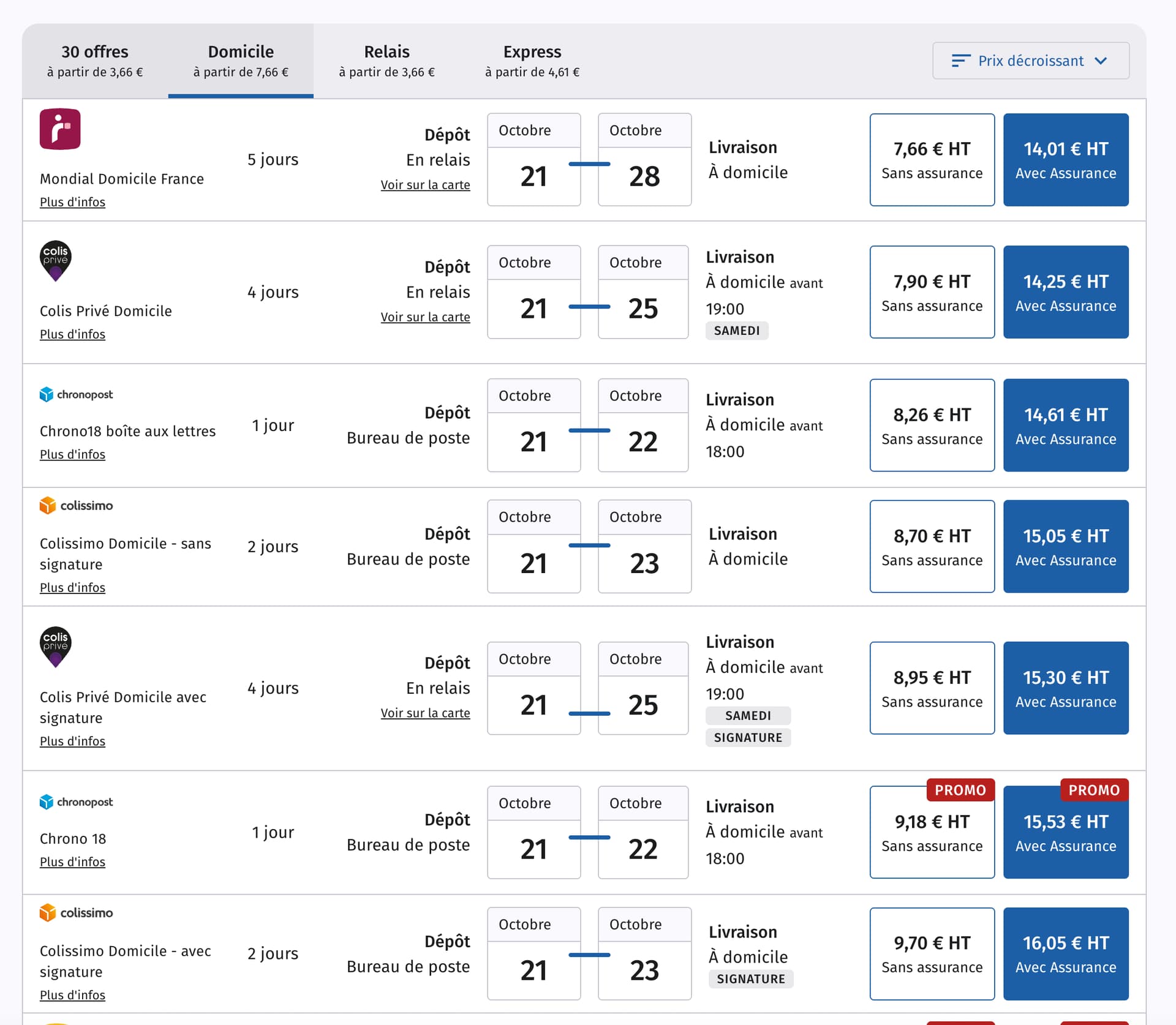
I’m looking at delivery offers, and actually it’s really expensive when sending not-cheap items with insurance :face_with_spiral_eyes:

Mondial Relay (relay point or home delivery) :

Shop2Shop (relay points only) :

Colissimo, I won’t even mention it, it’s €12.50 without insurance + €4.70 insurance = €17.20!!

Do you know any tips for sending parcels cheaply?

The other option, otherwise, is not to take insurance, but lost parcels happen far too often to skip it…

Thanks for your reply @mutmut! I’ll try anyway and we’ll see whether there’s any demand or not :wink:

Good point, it’s true that the 1-year option was a bit long. 6 months is more than enough to test.

If you have any tricks to get more, I’m always interested :wink:

1 Like

When I had my company, we used 2 shipping providers (the cheapest one since it can change every day):
Packlink Pro and Boxtal

1 Like

Thanks for the tip, super handy!

Actually it’s always the insurance that’s the problem:

Looking into it a bit, I discovered there are third-party insurance options cheaper than the insurance offered by default on these platforms — I’m digging deeper!

1 Like

I don’t know if I’m going to move things forward because I don’t have any delivery expertise, but why not let the buyer take charge? More and more online shops let the buyer choose the delivery method and it’s up to them to decide how much they want to pay. Of course, you have to be clear about the services associated with each type of delivery (notably insurance), but I think everyone should take responsibility and decide whether they prefer to pay more for insurance or pay less with a risk of not being delivered. I know that if a buyer isn’t delivered, their first reflex will be to turn on the seller, but, well, at some point you have to stop catering to people. Okay, maybe that’s a bit of an extreme reaction, but I find that we’re assisting people more and more when, on the contrary, we should be making them responsible (maybe I’m straying from the topic). In the end, I would offer several delivery options and make the buyer bear the cost.

1 Like

If a customer orders a product online, they should not be held responsible for a subcontractor’s negligence and it is not up to them to bear the loss of a package.

It is even illegal under French law according to my research:

This is not about enabling people, on the contrary it’s about protecting them from abusive sellers on the internet.

In any case, regardless of the insurance I take out, I will directly reship another mini-PC in the event of a package loss, with no extra charge to the end user. That seems rather obvious to me :slightly_smiling_face:

1 Like

The basic coverage applies based on the declared weight of the parcel; generally it’s not much.
With what we were selling, we were around 20 kg per parcel and we never took out additional insurance because the coverage (I don’t remember how many euros per kilo, it depends on the carrier) covered our production costs (and we had one dispute that was refunded).
You’d need to check exactly what the carrier reimburses per kg.

1 Like

Sorry if I shocked you, but what I meant is that the buyer must also take their share of responsibility and agree to pay the insurance associated with delivery.

The difficulty is finding the right balance between a solution that allows you to protect yourself and not lose money and a delivery cost that the buyer can reasonably bear. But here, I don’t have enough expertise in the matter to be of any help to you. Sorry.

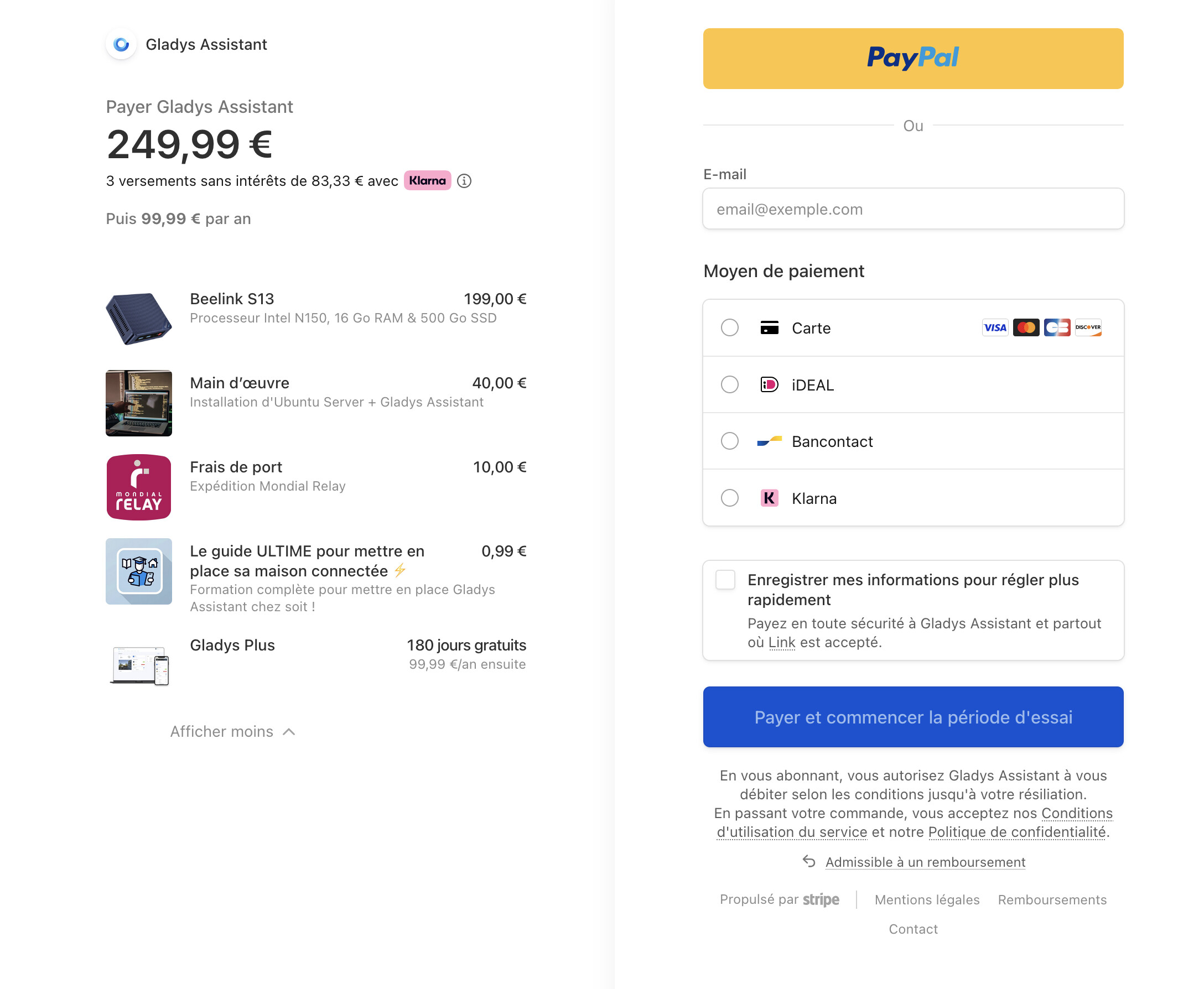
First offer proposal for the Beelink S13:

3 Likes

Overall I think it’s good.

I have two suggestions:

  • in the same way you have a sentence that highlights the training, you could have one that highlights delivery (to underline that you chose a guaranteed shipping method and that the user takes no risk), the labor (to underline that with this, the user will have nothing to do, they will receive equipment ready to operate), and maybe also the mini PC (to underline that it is perfectly suited to this or that use)
  • You explicitly state the ā€œā‚¬99.99 per year thereafterā€. But I assume there will be the possibility to unsubscribe from Gladys plus at the end of the first 6 months, and that you are counting on the 6-month trial to convince people to keep this service. So it would seem better to present that as an option so it doesn’t give the user the impression that they will be obliged. For example ā€œā‚¬99.99 per year thereafter to keep Gladys plusā€
3 Likes

… and add two compatible outlets (WiFi, ZigBee + dongle, Matter?)

At first, that was my problem. I didn’t know, didn’t understand the protocols, etc. So I was afraid to buy things and have them not work (or not work well), of not having the right antenna, router

4 Likes

[quote="GBoulvin, post:59,

2 Likes

The prices offered seem quite affordable to me. Like StĆ©phane B, I think it’s useful to remind what Gladys+ is for and, above all, that the person is not obliged to keep the option after six months.

But be careful, price is not the only criterion for choosing a home automation solution.

Personally, I discovered home automation with an eedomus box (a very good box for starting out, by the way) but I quickly discovered the complexity of the protocols (EnOcean, Zigbee, Z-Wave …) and the multiplicity of available devices.

I then wanted to integrate the various devices I had (Philips Hue bulbs, Nodon smart plug, Airzone air conditioning ….) and I quickly realized that home automation was far from being as accessible as people like to say.

The idea of providing dongles for the most common protocols seems like a good idea to me. Even if that increases the price, I think people will prefer to have Ā« plug-and-play Ā».

1 Like