Belgium is finally beginning to modernize regarding access to its customers’ real-time consumption data by installing new smart meters.
These send data to the network operator but have a port (P1) allowing access to this data directly by the consumer.
With very little hardware, it is therefore possible to read this data and transmit it to a home automation hub such as Gladys Assistant.
I will cover two parts here. One hardware part allowing access to the data and transmitting it to Gladys, the second being the integration of this data for use in Gladys Assistant.
There is ready-made hardware for which you can find a (non-exhaustive) list on the following site: Examinez et comparez - Ma Conso Sous La Loupe (I haven’t tested any of them!)
But it is also possible to build your WiFi communication device quite simply.
I was inspired by these two sources:
You need a Wemos D1 Mini (or equivalent), a 10k Ohm resistor and an old four-wire telephone cable with a square jack (RJ11). If you have 6-wire ones, you can even do without external power (personally, with an additional capacitor)! Here is the final result (the theory):

The practice:

I first did many tests before arriving at an optimal solution that uses a bit more hardware. However, a « cheap » version is of course possible, even without a soldering iron.
The principle is as follows:

And with direct power from the electricity meter:

Personally, I had to add a 470µF capacitor between 5V and GND because the Wemos would not start without it. Result:

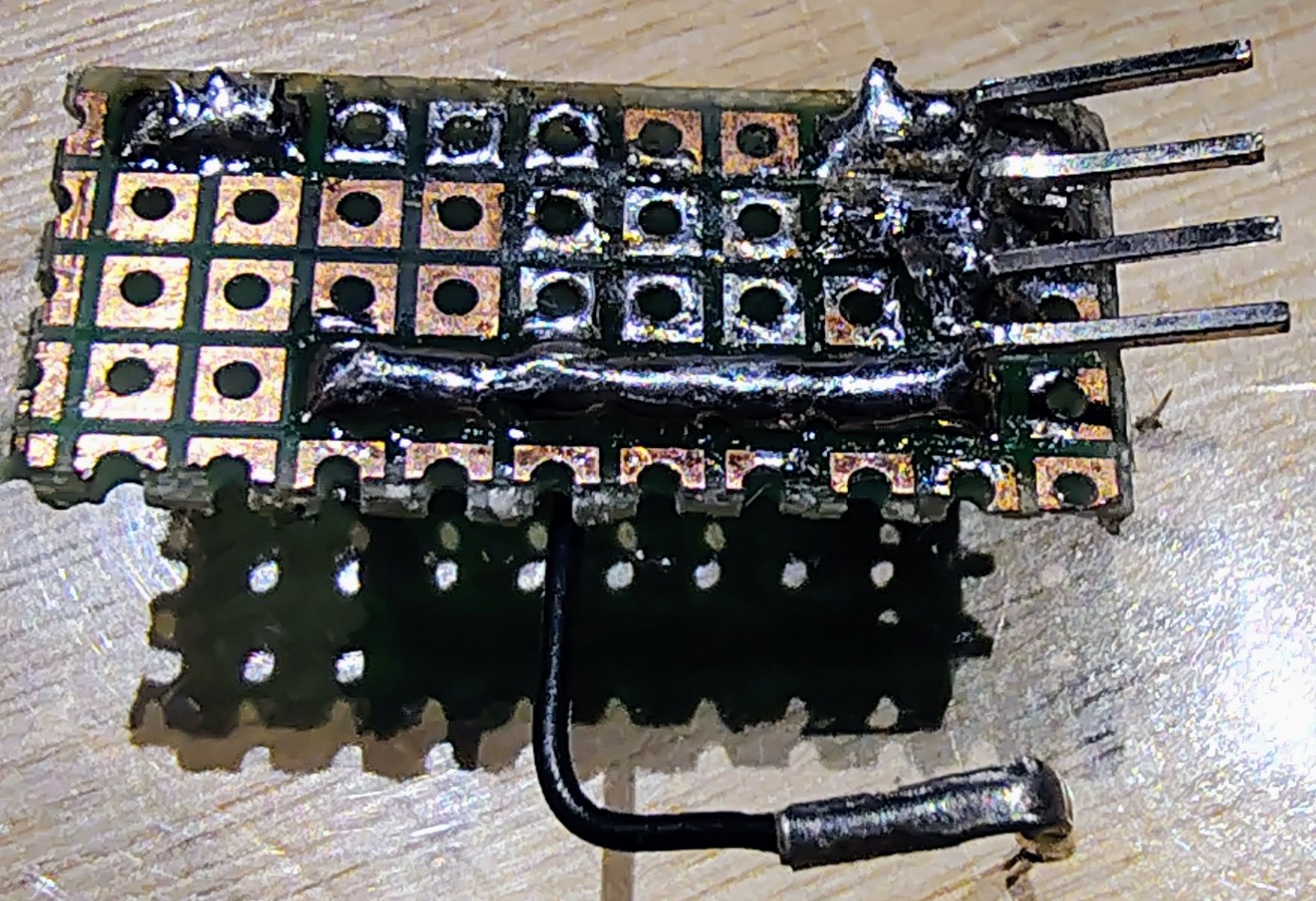
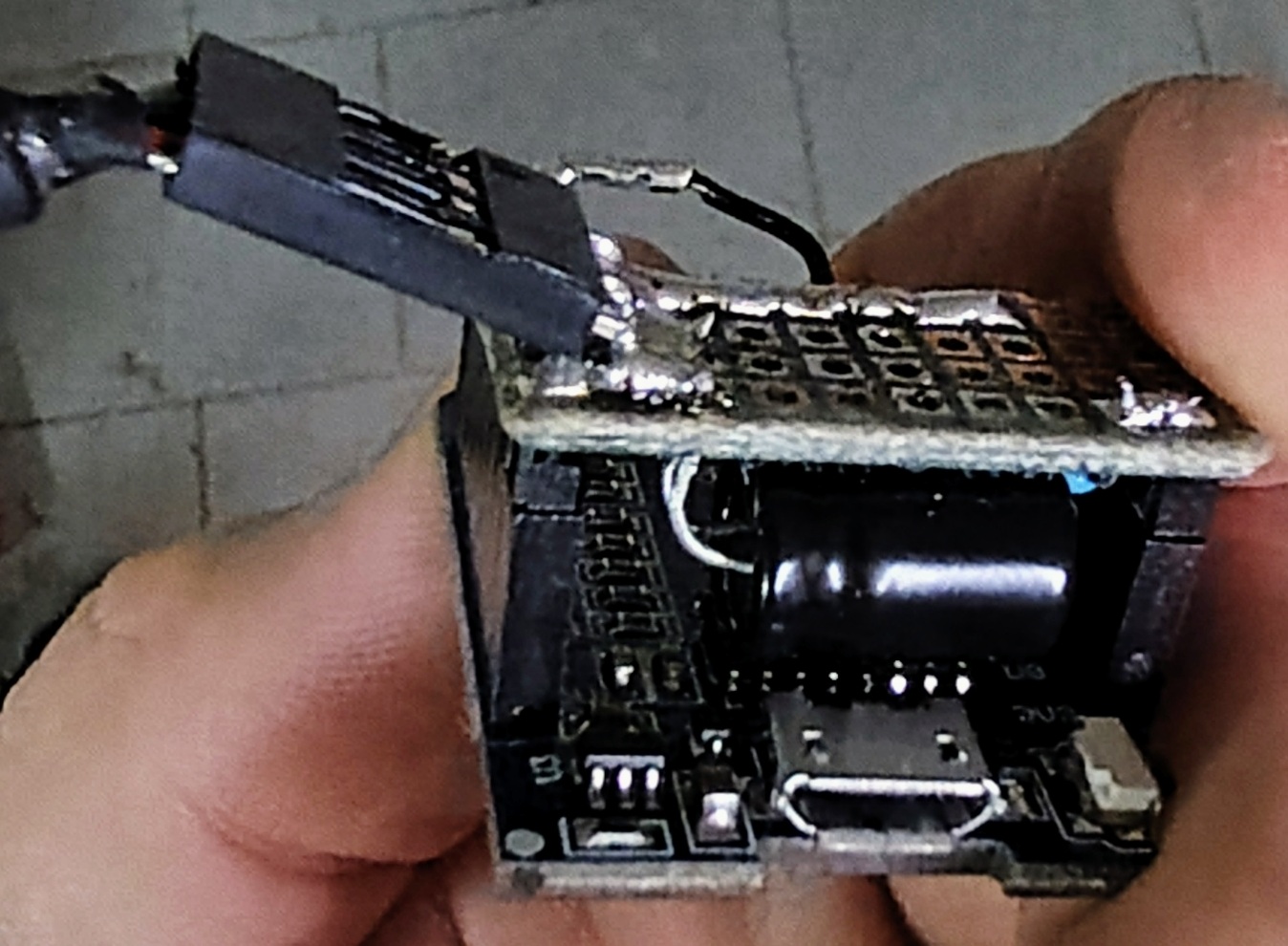
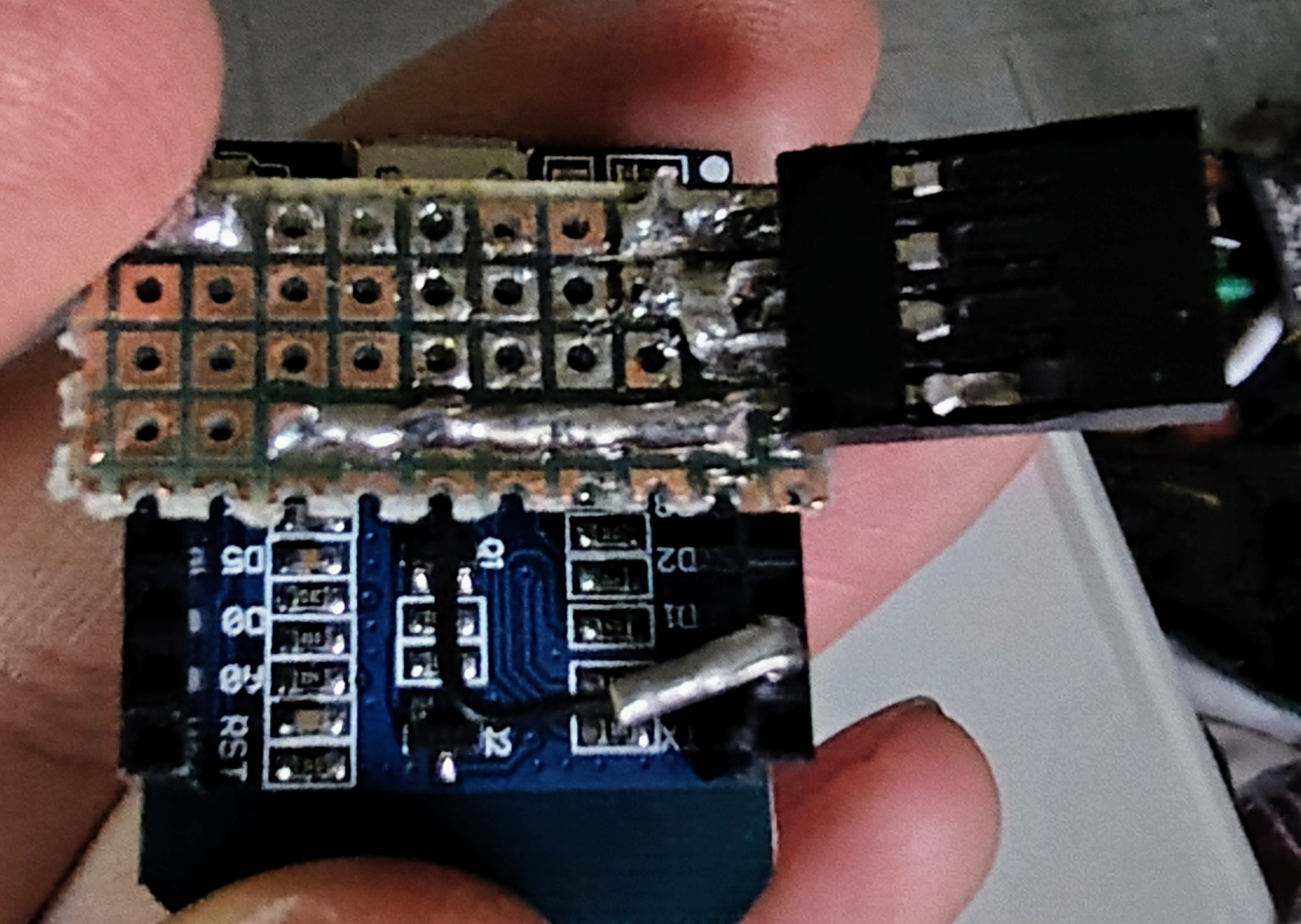
The program added is the following: esp8266_p1meter/esp8266_p1meter/esp8266_p1meter.ino at master · gboulvin/esp8266_p1meter · GitHub (with its file “settings.h” to complete), all uploaded to the Wemos using the Arduino IDE application.
If you want me to detail this section, please let me know (don’t hesitate to ask your favorite AI of course)!
The data acquisition takes place in Gladys’ MQTT integration. I assume this part is functional because you have already configured the integration by following the doc.
So create a new MQTT device that you can configure like this:

What data do we get?
- Voltages and currents on the phases (1 and 3 in Belgian three-phase)
- Consumption indexes (Peak hours and off-peak hours (respectively called Tariff 1 and 2))
- Injection indexes to the grid (identified as above)
- The tariff (1 or 2 for the moment)
- Instantaneous power
- (optional and not explained here: number of long and short power outages).
The MQTT topics must be customized (I may change that in the future). Just copy-paste the topic into the corresponding field:

Phase 1 voltage: sensors/power/p1meter/l1_voltage

Phase 3 voltage: sensors/power/p1meter/l3_voltage

Injection High tariff (peak hours): sensors/power/p1meter/returndelivery_high_tarif

Injection Low tariff (off-peak hours): sensors/power/p1meter/returndelivery_low_tarif

Consumption Low tariff (off-peak): sensors/power/p1meter/consumption_low_tarif

Consumption High tariff (peak): sensors/power/p1meter/consumption_high_tarif

Instantaneous power: sensors/power/p1meter/actual_consumption

Tariff: sensors/power/p1meter/actual_tarif_group

Phase 3 current: sensors/power/p1meter/l3_instant_power_current

Phase 1 current: sensors/power/p1meter/l1_instant_power_current
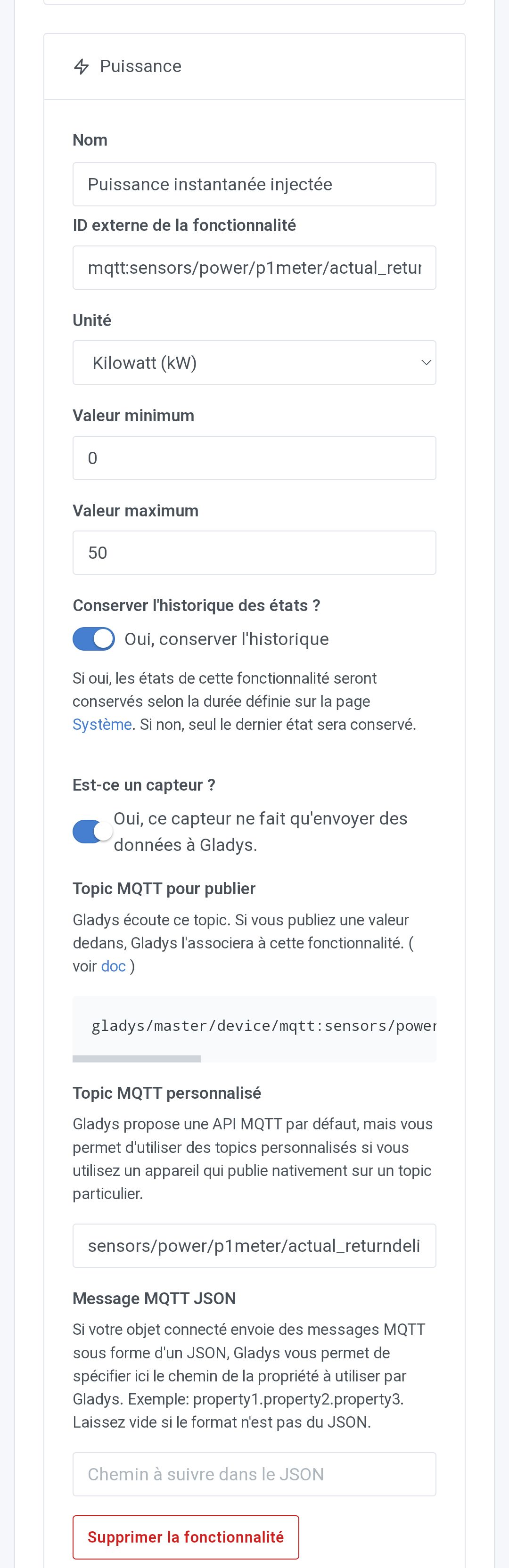
And the last one: Instantaneous injected power: sensors/power/p1meter/actual_returndelivery