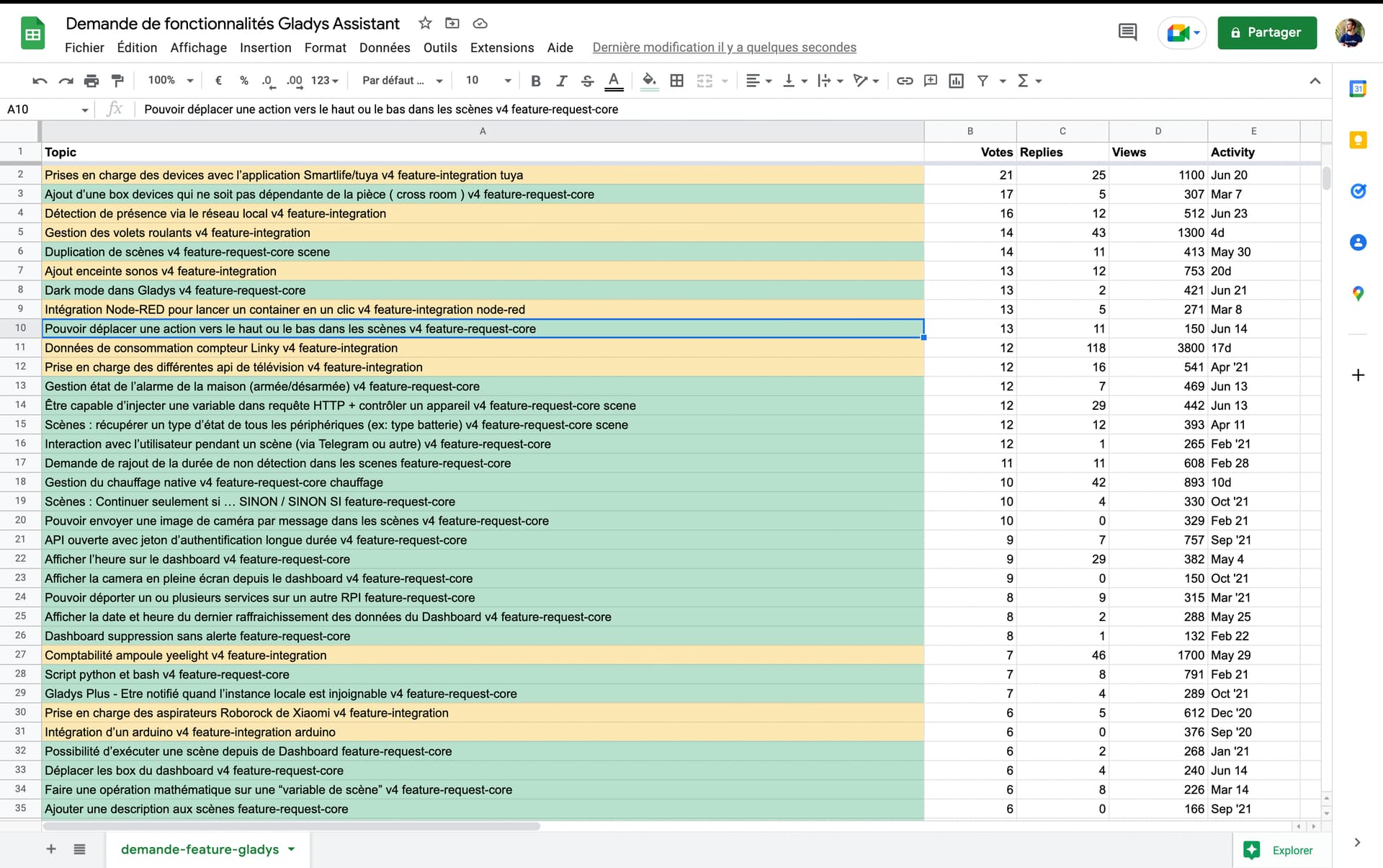
I had fun extracting all the feature requests from the forum and sorting them by number of votes / number of views, while indicating whether the request is a core request or an integration.
What I find interesting is that when you look at this list ordered by number of views, there is a large majority of integration requests, and I think that better represents the requests of the community’s « external » members who browse Gladys without necessarily voting because they don’t have accounts.
Now the question is how to motivate people to develop these integrations / test ongoing developments?
The other question I have is whether we’ve reached a certain level in terms of core features, and whether my time over the coming months should be dedicated to work related to integrations?
Because unlike previous months, I no longer see any « big key features » missing from the core for Gladys to be attractive; I have the impression it’s mostly a matter of missing integrations (aside from roller shutters and heating management, but those topics are ultimately very tied to integrations).
Frankly, the core is robust and most requests are additions to improve it further (heating management, disconnections, improving support for multiple devices, etc.).
We need to decide whether supporting more integrations will provide better visibility or whether quality should take precedence.
Personally, even though I’d prefer to see certain features added, I think that more integrations will allow greater visibility to attract even more people.
I’m increasingly convinced it’s an integrations problem!
Currently many people simply don’t use Gladys because we don’t support their devices; that’s the main feedback from the survey I did at the start of the year, and from feedback I’ve gotten on external forums.
I’m particularly thinking of:
Tuya
Z-Wave
Shelly?
Yeelight
Netatmo
Somfy roller shutters
Sonos
More Zigbee compatibility
And we’ll probably have Matter added to that list, hopefully this will finally be the end of the mess of proprietary protocols
I completely agree that priority should now be given to integrations.
As I’m not a developer, that’s why I paused my use of Gladys for several months (during which I tested Home Assistant and its MANY integrations).
I think that to reach more potential developers, you first have to reach more people, quite simply!
I share your points of view. More people is potentially more devs. But also more ideas
@pierre-gilles for me we should first handle storage optimization when we have many sensors in « unlimited » mode, because it can quickly become problematic for several newcomers.
I think so too! But to have integrations you need users/developers, and to have developers you need integrations — it’s the vicious circle
Also, if any of you have leads on how to attract devs, I’m all ears!
For now, I believe in it! We have standards on most IT systems (Wi-Fi for wireless internet, Bluetooth for audio, etc.), and given the firepower of all the players (Apple/Google), there’s a good chance it could take off. At least I hope so
We’ll see, because it’s already been more than two and a half years that I’ve been doing nothing but the core of the core of the core non-stop on v4, and for now despite all the features I add growth is rather slow, so I’m asking myself questions!
This has to change, and if I keep working on core over the next months, will the project progress, or have we reached a ceiling with the integrations currently offered?
I largely agree about the need for integration but I find that there’s still a missing user-friendly action that would allow you to do a lot of things: executing a command simply by passing arguments (values).
The current system is far too complicated.
I think there would be so many things you could do if you could simply call a Python or Bash script from a scene.
Personally I’ve put my usage on hold for that reason and because of the lack of support for roller shutters (the famous point everyone agrees on :))
In any case, thank you and well done for all the work!
I’m also in favor of integrations. The current lack requires going through Node-RED, even using competing applications (Home Assistant), and then communicating via MQTT between systems! It works, but it’s a Rube Goldberg machine.
Following what we discussed, I think it would be nice if we created a feature request per integration from this list (for those that are missing):
For each integration, it would be good to organize how it will operate:
A « main point of contact » (the integration developer)
Several testers who have the hardware, or who are willing to acquire the hardware
If we document the process, set up funds to buy hardware for those who need it, and organize regular development follow-ups, I can handle communications to attract people and create some momentum around all of this
On my side, my role is up for debate: I can start developing integrations, but I’m not really sure that’s a good idea, because once the integration is developed I won’t be able to maintain it anymore (my « fixed » workload on Gladys is quite significant: PR review, communication, development and support on Gladys Plus, etc…), and my number of available days remains limited.
I think the approach of having a point person per integration, as is currently the case, is a good idea!
Hello everyone,
I’m taking the liberty of sticking my two cents in since this discussion is ultimately strategic about the future development of Gladys.
In terms of financial means, it seems to me it would be great if we could accept tax-deductible donations. I looked a bit into how to make that legal and creating an association and applying to a government body would seem sufficient, knowing that the justification of developing tools that enable energy savings appears to be a sufficient reason. I think that would allow more substantial support for Gladys and provide more resources for development, knowing that the server bills for Gladys Plus could be paid directly by the association and it could pay development days to @pierre-gilles or other developers. After that I don’t know if there are many people willing to make larger regular donations and take advantage of the tax deduction. But it seems like an interesting way to make it more financially worthwhile for you @pierre-gilles. And it would probably provide more resources for communication.
So for me, heating is still sorely missing, which is a very important part of energy management. Today I don’t feel really limited by integrations if we consider integrations into Gladys from the start, but that’s certainly not the case for most users.
So, tell me what you think,
In any case, interesting question
Afterwards, following my -50% offer mid-year, we reached a relatively good Gladys Plus subscriber rate compared to the number of Gladys users, so for me it’s not a user/contributor conversion problem — I see that people who use Gladys are clear-sighted and support the projects they use.
For me the problem now is clearly a usage issue: we need to entice more people to join the project. And currently, the biggest hurdle is integrations! Hence this topic
But clearly, those who are active in the community are also financial supporters.
Otherwise you can go through Node-RED, since in any case what you want to do in the end is something very « power user », it’s not for the general public
Hello.
I’d really like to try Gladys, which seems very interesting to me, but since I already have Homey, I was wondering whether Gladys would be of any interest to me.
And I asked this question several months ago to Pierre-Gilles who, unfortunately, never replied to me. Too bad — one less potential user…
Sorry to intervene in this discussion, but when I read that PG wants to increase the number of users, I can’t help but point this out
Kind regards.
You asked me where? I sometimes miss messages, sometimes I’m on vacation But generally I reply when someone asks me questions!
Gladys can still be an add-on, it depends on what you want to do. I invite you to create a thread on the forum to talk about your project / current installation
I’m back with the RFX 433 MHz
There might be a way to integrate this with something like Dashticz!
This would also avoid having to replace a large part of the hardware.




 But generally I reply when someone asks me questions!