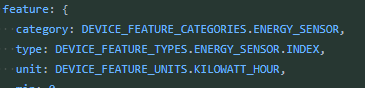
All the work I’m doing on the Enedis API is « generic » as usual, I use a category and a type that already exist in Gladys (ENERGY_SENSOR)
We should coordinate so that this work is applicable to the work you did on the Lixee TIC, and on the MQTT integration so that it’s open to any external data import.
What category/type are you already using on the Lixee TIC?
Ok, and we’re agreed on the Lixee TIC data side — if on the Gladys side I do a (roughly):
SELECT SUM(value)
FROM device_feature_state
WHERE device_feature_id = 'xx'
AND created_at >= '2022-12-01 00:00:00'
AND created_at <= '2022-12-01 23:59:59'
We need to distinguish the two with a different type.
On the Enedis side, I have access to 2 APIs:
Consumption load curve: This sub-resource returns the values corresponding to measurement days of a customer’s consumption load curve for each day in the requested period. The returned values are average power consumption values over the meter’s measurement interval (default 30 minutes). Each value is timestamped. The load curve is obtained for full days from midnight to midnight of the following day in local time. A call can cover at most 7 consecutive days. A call can request data dating back at most 24 months and 15 days before the call date.
Daily consumption: This sub-resource returns the values corresponding to the daily consumption (in Wh) for each day in the requested period. Each value is dated. A call can request data dating back at most 36 months and 15 days before the call date.
On your side, basically you have a variable that is always the sum of the previous variable and the consumption that has occurred since then?
It’s the meter index; it always increments, yes that seems to be what you’re describing (there is no operation, it’s the meter that provides the value)
Ok, in that case it’s really a completely different job to calculate consumption and price ^^
The work I’m doing on Enedis will not be applicable to Linxee TIC, we’ll need to do special work to be able to deduce hour-by-hour/daily consumption data from the meter index.
I second Spenceur’s remark because it’s the same for me: two off-peak (HC) periods
I can’t wait to see how this integration turns out because I already have my Solaredge integration (solar panels) and I’d like to see more precisely what’s happening on the Enedis side


 I’m just interested in data in the broad sense! Great work in any case