Hello everyone,
As announced in the thread about integrations to develop, here is an external integration for Magic Home Wi-Fi bulbs, LED strips, and plugs, controlled locally.
What it does
It brings Magic Home Pro, Zengge, or Surplife app devices into Gladys: bulbs, strip controllers, addressable strips, garlands, plugs. Everything stays on the local network (local transport): no account, no cloud. Gladys finds the devices on its own (UDP 48899 network discovery), then the integration talks to them via TCP.
Gladys doesn’t have a native Magic Home integration: no need for the MQTT bridge (thread) or Matterbridge (thread).
Features
- Devices: on/off, brightness, color, and color temperature depending on the model; plugs as switches. Changes made on the remote control are automatically updated on most models.
- 2 scene triggers: a device stops responding (after 30 seconds), a device responds again.
- 4 scene actions: built-in effect (23 to choose from), up to 16 colors in loop, flashing then returning to the previous state, stopping the effect.
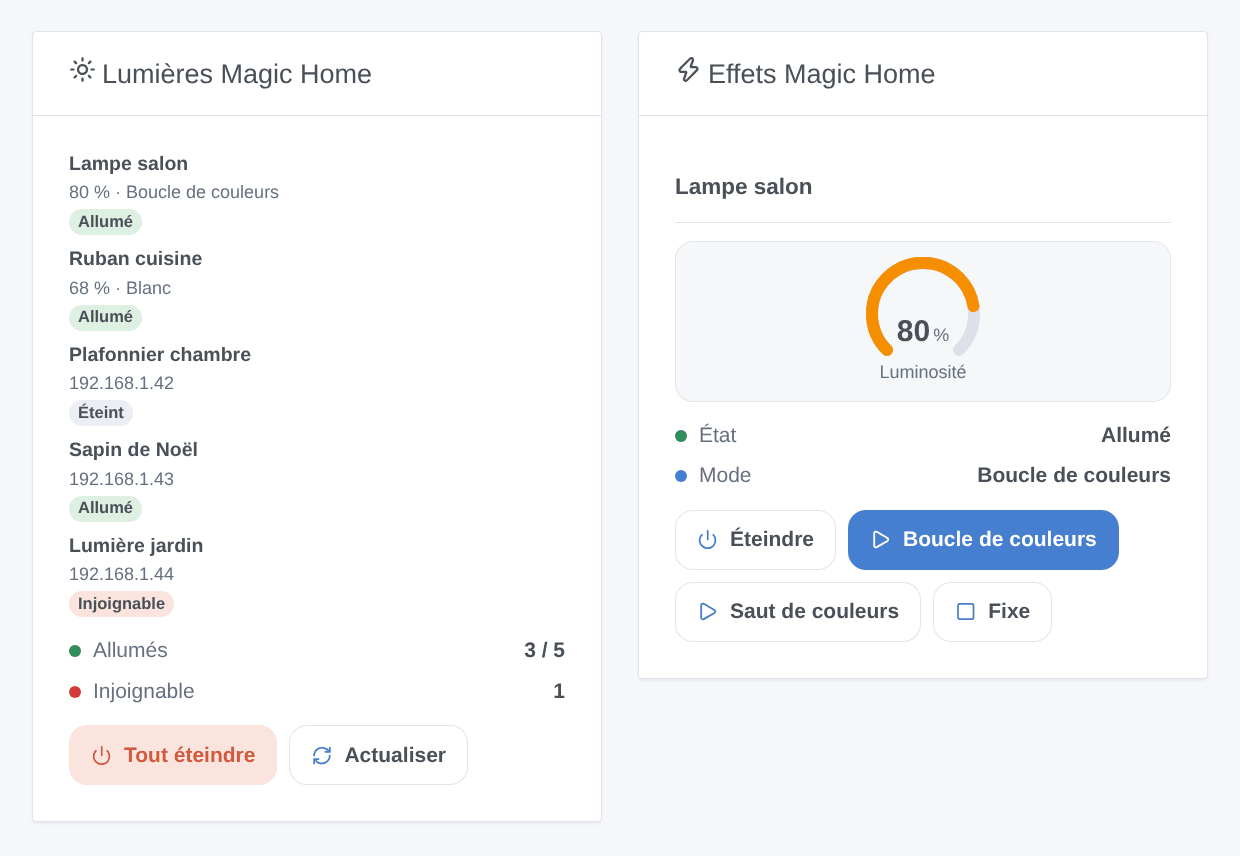
- 2 widgets: « Magic Home Lights » (with « All Off ») and « Magic Home Effects » (three effect buttons of your choice).
Scene examples:
- when someone rings the doorbell → make the living room lamp flash red for 5 seconds;
- when the garden light stops responding → send me a message (turned off at the switch);
- at sunset → kitchen strip at 40%, then an orange-pink fade on the living room strip.
[Screenshot to come: the Discovery tab with a bulb, a strip, and a plug]
Installation
- From the store: search for « Magic Home ». Available later today, pending indexing.
- Or from the repository URL:
https://github.com/William-De71/gladys-magic-home.
Minimum Gladys version: 5.1.1.
- Install the integration by accepting network discovery (UDP 48899).
- Configuration: « Search and test devices ».
- Discovery tab: add devices, then widgets and scenes.
Known limitations
- Protocol not documented by the manufacturer: I wrote it based on flux_led, which Home Assistant uses. Not yet tested on real devices, only against simulated devices with frames captured from real hardware: your feedback is precious (with the
MAGICHOME_MODELparameter). - Not supported: addressable strip and garland animations, music mode, timers, strip settings.
- 2 or 4 output switches are seen as a single switch; devices only reachable via the cloud are not supported.
Technical details
- One device per module, identified by its MAC address: it is found after an IP address change (automatic search every hour, and as soon as a device stops responding). A static IP is still recommended.
- The protocol is chosen based on the model number and firmware version: original protocol without checksum, 8 and 9 byte protocols, 25 byte HSV firmware of recent bulbs, encapsulated frames of addressable strips.
- One TCP connection per device created (they accept few, the app keeps one); discovered but not added devices are not kept connected.
- Color temperature is in mired, like Hue and Tasmota in Gladys.
- Scene actions never trigger a trigger (no loop); a cut of less than 30 seconds triggers nothing.
Provide feedback
Via a GitHub issue or in response to this thread, with the Gladys version, the integration version, and the logs