ZwaveJS2mqtt is deprecated? Or the node-red package?
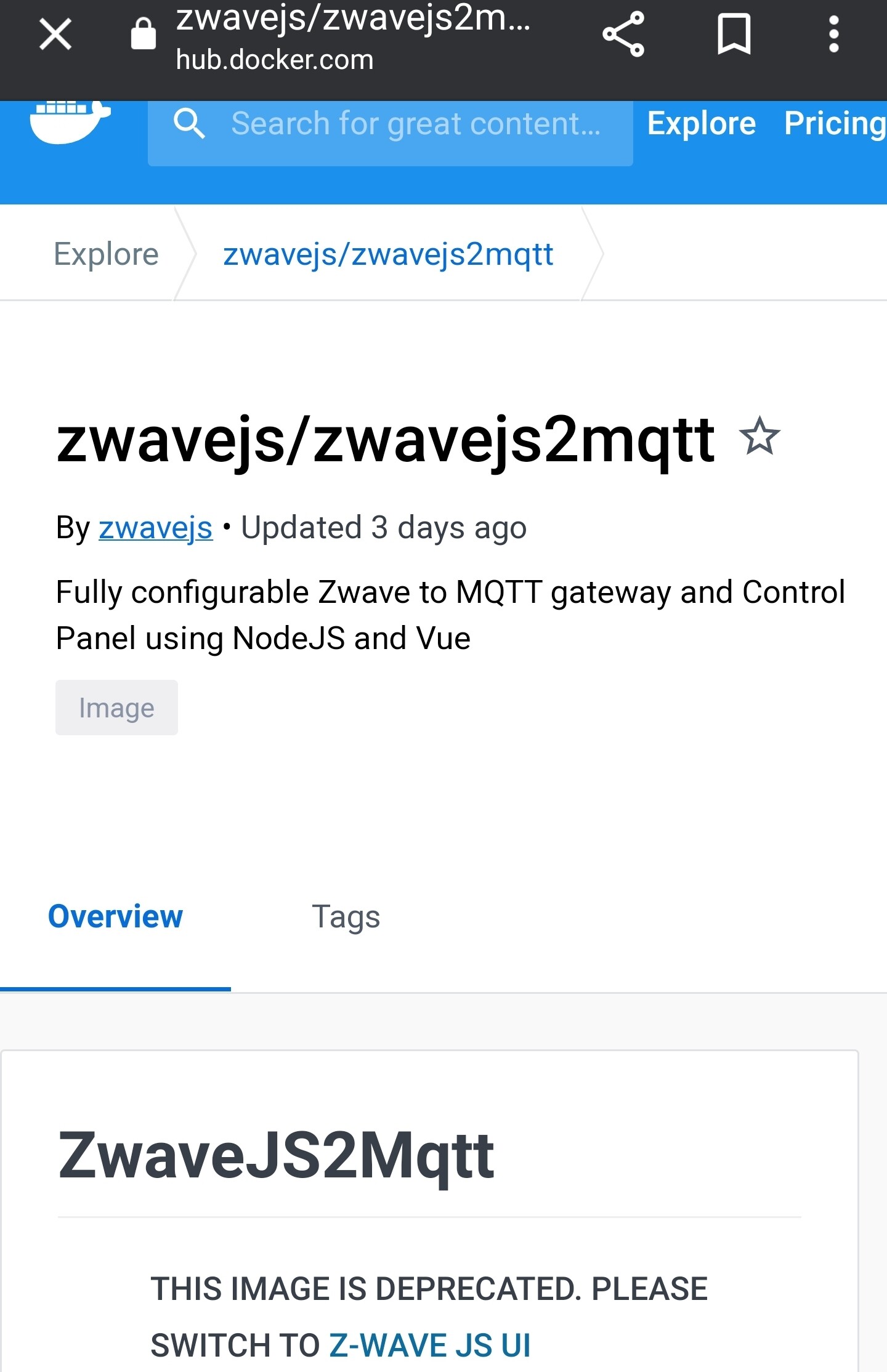
Ah ok, it’s just a naming issue! I didn’t know. https://hub.docker.com/r/zwavejs/zwave-js-ui
@Romuald_Pochet you’ll need to remember to choose the right image in the Zwavejs2mqtt integration — also, shouldn’t we rename the integration itself? 
Hello,
OK I’ll make the change to the Docker image ASAP.
Regarding the renaming, how to put it, it’s not the first time so I have the expertise  What would we go with; zwavejs, zwave-js-ui, zwavejsui ?
zwave-js-ui seems fine to me 
Hello,
Let’s go with zwave-js-ui… renaming tonight
Hello @_Will_71, first of all thank you for sharing.
By the way, I would like to do like you and use Node-RED to control my radiators. However, the information sent by my radiators (the temperature sent every 5 minutes by Tasmota) and the thermostat value from Gladys are asynchronous. Do you have the same problem at the input of your function? And if so, how did you resolve it? I feel it’s related to using the context but I’m going in circles.
Thanks in advance.
Hi @laguiche,
No, I don’t have any particular problem.
After all my inputs, I store the state in a file and I use the value saved in that file to do my calculations or actions.
I use this file because, for example, my temperature sensor doesn’t send its temperature periodically, especially if there is no change, so this file is useful to me in case of a power cut or Node-RED restart. Node-RED can then read this file to get the last temperature and not wait for the next value to be sent.
Is that a function you write yourself in Node-RED?
Good catch about saving to a file; I hadn’t necessarily noticed that in your screenshots. I was hoping there might be an internal mechanism in Node-RED for data persistence to allow me to synchronize the different inputs without work
That part isn’t visible in my screenshots because I wrote that in the thermostat function.
If you ever need it I could give you the function I used to save to a file.
Gladly  although for now I’ll try using the built-in Node-RED nodes.
Okay, I’ll explain it to you tonight when I’m home.
I had never paid attention to that part of your message.
I did a test with an Aqara sensor vacuum-sealed and submerged in my pool water: the problem is that the water prevents communication with my Zigbee coordinator.
I’m not great at soldering, but I got the gear to perform this hack:
A friend will help me with the small soldering. As soon as it’s done I’ll keep you posted!
[quote=« _Will_71, post:32, topic:7002, full:true »]
Ok, I’ll explain it to you tonight
Thanks @guim31, I had found that tutorial too but I’m not equipped to solder something that small. My soldering iron is a bit big😥.
Keep me posted and if it works well I’ll get the equipment to do it.
Ok, keep me posted if it works well. It’s the same principle I applied, but directly in JavaScript in the function node.
FYI, I have a PR open since May to do this directly via Gladys. But after my latest fixes I haven’t had any news. Maybe @pierre-gilles could pick it up: https://github.com/GladysAssistant/Gladys/pull/1496
The feature request is here, but no votes ^^ :
Ajout d'une requête APIRest Gladys permettant de récupérer les états des features sur une plage
Hi @Terdious,
That could indeed be nice to be able to do it in Gladys, but since I use Node-RED for my various calculations/actions I don’t mind saving a variable.
What I’m interested in, though, is only knowing the latest value of a sensor, so is it more sensible to make an API request or to save my sensor’s last state to a file?
It’s working like a charm, thanks! Now I need to test it over time.
In your case save the last value somewhere (file/or I don’t know if there is a key/value data storage provided by Node-RED)
I didn’t know there had been fixes from you! Given the very low demand for this feature, and the time it took, I ended up prioritizing other topics
I’m not sure I’ll get into that in the short term; my priority right now is really the Enedis API, which is in high demand and will have a real business impact!